

The rules for challenging a competitor's patent have fundamentally changed in 2026. Inter partes review (IPR) petitions have dropped 65% year-over-year to historic lows. Ex parte reexamination has overtaken IPR as the leading post-grant validity tool for the first time since the America Invents Act. Post-grant review (PGR) windows are closing fast, and third-party pre-issuance submissions are drawing renewed attention from IP strategists. If your patent challenge playbook hasn't been updated, it's already outdated.
In late May, I attended the 2026 MIPLA Stampede in Minneapolis and the Rocky Mountain Tech and Law Institute here in Colorado. At both events, the conversation kept returning to the same subject: how dramatically post-grant patent proceedings have shifted under the new administration. Whether you're in-house counsel, a patent litigator, or an IP strategist, the landscape looks nothing like it did two years ago. The window to act has tightened, the paths have changed, and the cost of not paying attention has gone up considerably.
Here is a practical breakdown of what's happening and what it means for your strategy.
1. Why Your IPR Petition Is Getting Denied (And What to Do About It)
Inter partes review (IPR) was once the go-to tool for invalidating a competitor's patent. File a petition, demonstrate a reasonable likelihood that at least one claim is unpatentable, and get a full trial before the Patent Trial and Appeal Board (PTAB). That playbook has been fundamentally disrupted.
The shift started in March 2025, when Acting USPTO Director Coke Morgan Stewart issued a memo bifurcating the IPR institution decision into two distinct steps. Instead of a PTAB panel jumping straight to the merits, the Director herself first decides whether to discretionarily deny the petition before it ever reaches the merits. Director Squires continued this practice. The result: IPR petitions dropped 65% year-over-year to a historic low.
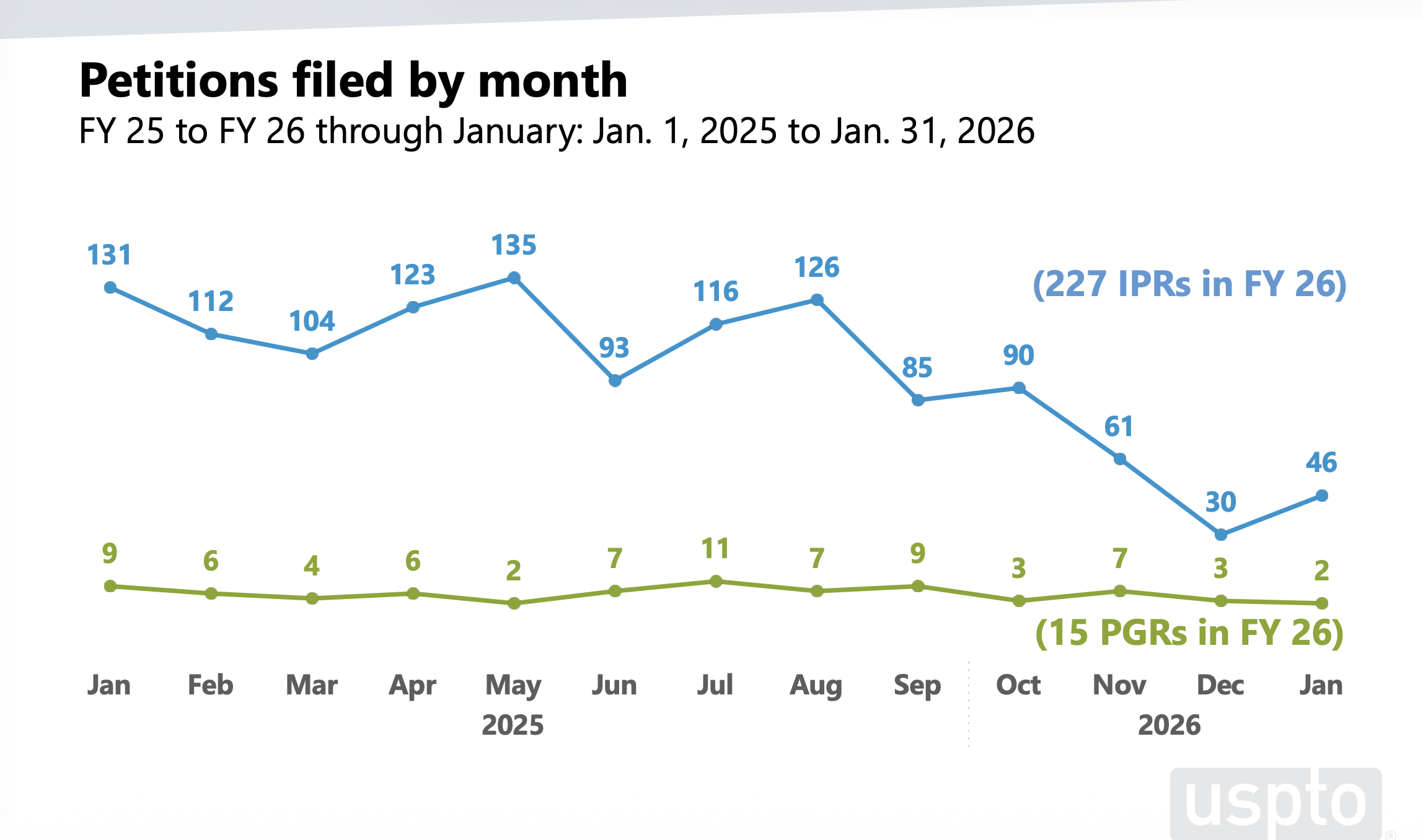

[Charts: PTAB Trial Statistics, January 2026, USPTO]
Because Director Squires now issues most discretionary denials as summary notices, the following factors represent practitioners' best educated guesses about what is driving these decisions. Lack of transparency means petitioners face genuine uncertainty about how any individual petition will fare.
"Settled Expectations" and Long-Term Knowledge
Two of the most consequential new denial grounds are closely related. The first is settled expectations: if a patent has been in force for years, particularly past the six-year mark, the Director may deny your IPR on the grounds that the patent owner has reasonably come to rely on the stability of their rights, regardless of what you as a petitioner knew or did.
The second is long-term knowledge: even if a patent is relatively young, if the record shows you were aware of it for years and chose not to act, the Director may deny institution on the grounds that your delay is itself a reason to protect the patent owner. Together, these two arguments create a powerful combination: the longer a patent has been around, and the longer you have known about it, the harder it becomes to get an IPR off the ground.
Parallel Litigation (Fintiv Factors)
The parallel litigation factors from Fintiv, which weigh whether a co-pending district court case makes the IPR redundant, are back in full force after being rescinded by the Biden administration in 2022. If your district court trial date is close, expect that to weigh heavily against institution.
The Squires Memo: U.S. Manufacturing Now a Factor
In March 2026, Director Squires added another layer. His memo introduced three additional discretionary factors: (1) whether the petitioner's accused products are manufactured in the United States, (2) whether the patent owner's competing products are made domestically, and (3) whether the petitioner is a small business that was sued for infringement. The framing is explicitly tied to the Trump administration's reshoring agenda. The USPTO is signaling it does not want IPR weaponized by large foreign manufacturers against domestic patent owners.
Other Key Denial Grounds
- Follow-on petitions (General Plastic factors): A second IPR on the same patent faces a very high bar.
- Cumulative prior art (Becton Dickinson factors): If the petition relies on art the examiner already considered, it may be denied as redundant.
- Overreliance on expert testimony: Obviousness arguments plugged with expert opinions about what a skilled artisan "would have known," rather than actual references, may draw skepticism.
- Real Party in Interest (RPI) issues: Failure to disclose all parties with a financial stake can result in outright denial.
- Foreign sovereign as petitioner: Foreign governments and state-owned enterprises face heightened scrutiny, with a precedential decision specifically addressing this concern.
Strategic Implication: Warn Your Competitors Early
One genuinely counterintuitive piece of advice that has emerged from the settled expectations doctrine: patent owners should consider sending notice letters to competitors shortly after a patent issues. The goal is to build a record showing that potential challengers were aware of the patent early on, which supports a future argument that the petitioner had long-term knowledge of the patent, an independent ground for discretionary denial.
2. Post-Grant Review (PGR): A Narrower Window, But the USPTO Is Encouraging Its Use
Post-grant review (PGR) can only be filed within nine months of a patent's issue date. But PGR is also broader than IPR. You can challenge a patent on any ground of invalidity, not just prior art. The current USPTO is actively encouraging its use.
The nine-month PGR window creates an urgent operational imperative that many companies are not adequately addressing: you need to be monitoring your competitors' issued patents in near real-time.
The right approach is continuous surveillance of competitor filings and issuances, with a defined internal triage process. When a patent issues in your technology space, you want to be reviewing claims within days, not months. Tools that aggregate USPTO issuances by assignee and technology class, and that can flag potentially problematic claims against your products, are no longer a nice-to-have. In the post-IPR world, the nine-month PGR window may be the most viable formal challenge path you have.
3. Ex Parte Reexamination (EPR): The Comeback Tool of 2026
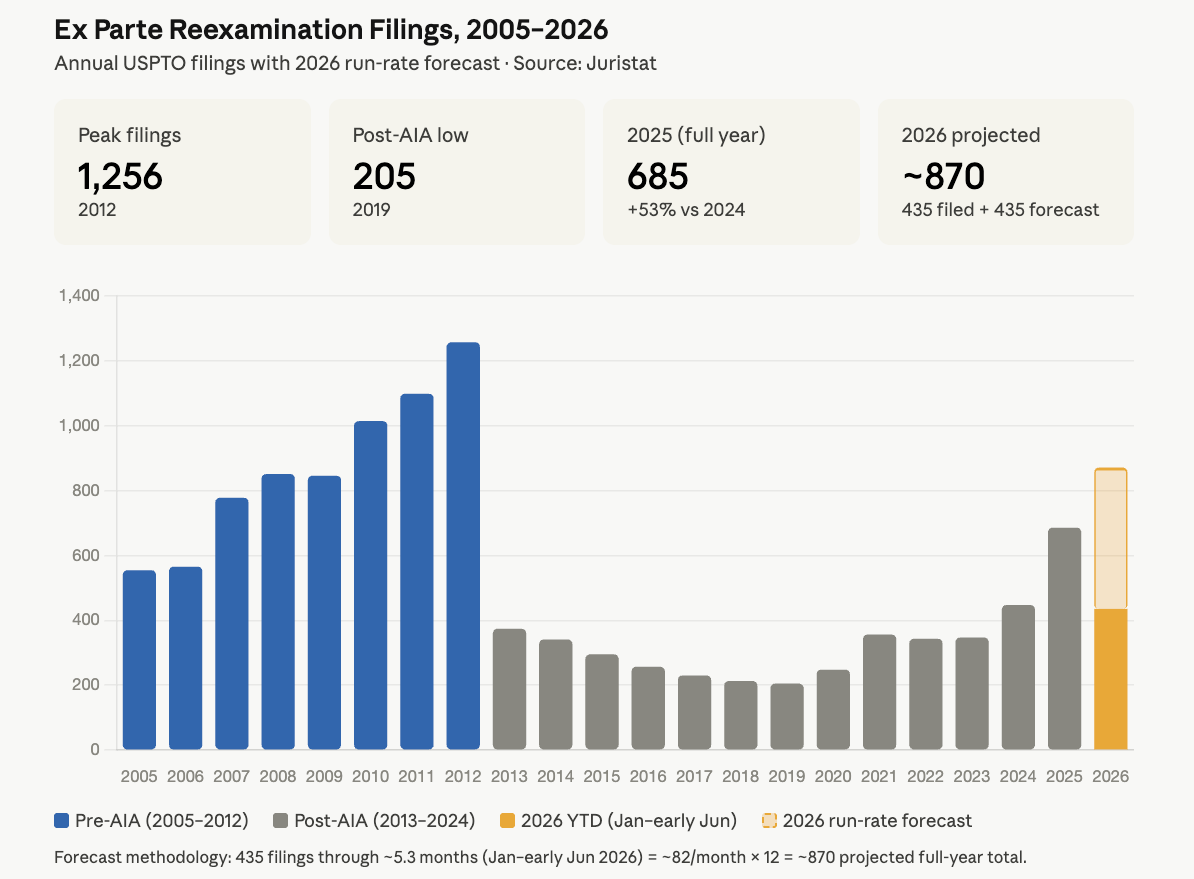
When IPR became harder to obtain, practitioners turned back to an older tool: ex parte reexamination (EPR), which has existed since the 1980s. The numbers tell the story: after bottoming out at 205 filings in 2019, EPR requests have surged, reaching 685 in 2025, a 53% jump over 2024, and already on pace for roughly 870 filings in 2026 based on the current run rate.
Why EPR Is Attractive Right Now
- No parallel litigation bar
- No standing requirement
- Lower cost than a PTAB trial
- More lenient institution standard (exceeding 90%)
- No IPR-style estoppel: an unsuccessful EPR generally does not bar you from raising the same prior art in district court
The Downsides
Once ordered, you largely lose control. The patent owner corresponds directly with the examiner, the process can take years, and the patent owner can amend claims, potentially emerging with a narrower but still valid patent.
A Critical New Risk: The § 325(d) Trap
On May 22, 2026, the USPTO denied an EPR request under § 325(d) because the prior art cited had also appeared in a prior IPR petition, which had itself been discretionarily denied without any merits review. In Geotab Inc. v. Fractus, the same prior art arguments were blocked twice, and the validity question was never actually decided. It raises a serious question: can a discretionary IPR denial effectively immunize a patent from all post-grant challenge, including proceedings that were supposed to sit outside the discretionary framework entirely?
New Pre-Order Paper Procedure
Starting April 5, 2026, patent owners can file a "pre-order paper" of up to 30 pages within 30 days of being served with an EPR request, arguing the cited art does not raise a substantial new question of patentability. The goal is to kill the EPR before it is even ordered. Note: an aggressive or overreaching pre-order paper could invite a limited 10-page reply from the requester (one the requester would not otherwise have had) and potentially draw scrutiny of the patent owner's own characterizations of the prior art.
4. Third-Party Pre-Issuance Submissions: An Underused Tool That Just Got More Valuable
With post-grant proceedings harder to obtain and EPRs becoming more contested, more practitioners are turning to a quieter but effective tool: third-party pre-issuance submissions under 37 CFR § 1.290.
How It Works
Once a patent application is published (typically 18 months after filing), third parties can submit prior art (patents, published applications, journal articles, or other printed publications) directly into the prosecution record of a pending application. The examiner is required to consider the submitted materials. This tool was created by the America Invents Act specifically to improve patent quality at the examination stage, before a patent ever issues.
The Window and the Rules
You have until the later of six months after publication or the date of the first office action rejecting any claims, but no later than a notice of allowance. The first submission of three or fewer documents is free. Beyond that, the fee is modest (around $180 for large entities per ten documents). You do not have to serve the applicant, and the submission does not directly reveal your identity in a conspicuous way, though the existence of the submission does appear in the file wrapper.
Why It Matters More Now
In the current environment, where post-grant challenges have become harder, more expensive, and increasingly subject to discretionary denial, preventing a bad patent from issuing in the first place is far more efficient than trying to kill it after the fact. Third-party submissions let you put your best prior art in front of the examiner while prosecution is ongoing, when claims can still be rejected and before the patent owner has settled expectations in the issued patent.
This makes monitoring published competitor applications an essential business practice. If a competitor publishes an application with claims that could cover your products, you may have a limited window to submit prior art that limits how broadly those claims can be drawn. A narrower patent, or one that never issues, is cheaper and easier to deal with than an issued patent you have to litigate or challenge through post-grant proceedings.
Operationalizing This at Scale
A well-designed monitoring program tracks competitor applications from publication, flags claims of concern, and surfaces relevant prior art for potential submission. Given that many competitive technology areas see hundreds of publications per year, automated monitoring tools have become a practical necessity.
GenAI connected to live patent data has made this kind of real-time monitoring achievable in practice. By attaching Juristat's MCP server to AI tools like Claude, ChatGPT, or Microsoft Copilot, any IP team can run real-time competitive surveillance in plain language, on demand, without waiting on outside counsel to prepare a monitoring memo.
The screenshots below are pulled from a real monitoring report, identifying nine active PGR and 3PS targets across primary competitors for an example assignee. The first view shows the full docket sorted by deadline urgency, with color-coded days remaining to make triage instant. The second view drills into a single high-priority target. The card surfaces the prosecution timeline, maps each claim element to the assignee’s own IP with a suggested basis for challenge (§102, §103, or §112(a)), and closes with a recommended action.

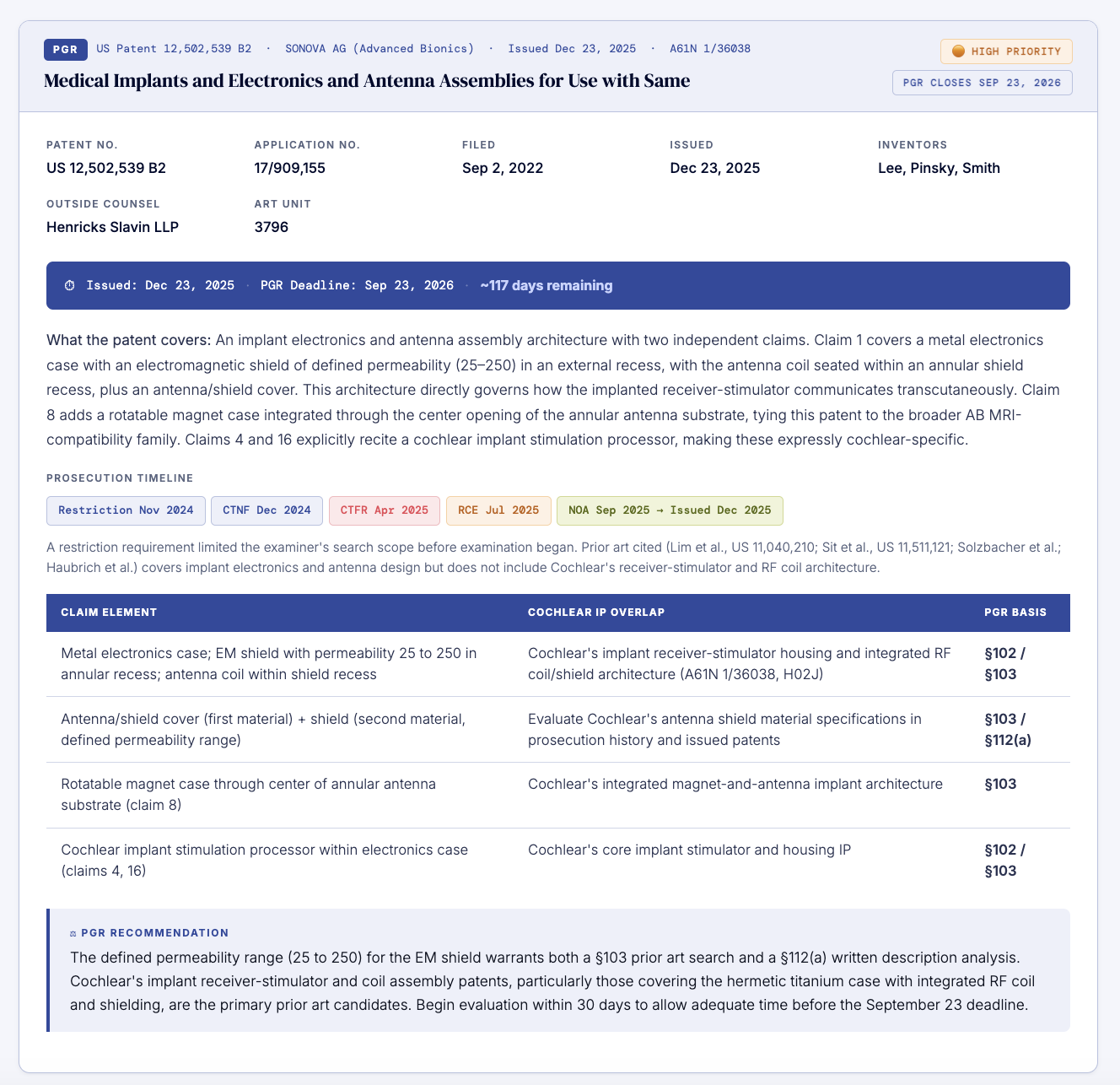
[Screenshots: PGR and 3PS monitoring report showing nine active targets for a example assignee, sorted by deadline urgency with color-coded days remaining. This was created with Juristat’s MCP connected to Claude.]
This is exactly the kind of operationalized monitoring program that turns competitive intelligence into timely action before the window closes and the only remaining option is expensive litigation.
What This Means Moving Forward
The era of IPR as a readily available, low-risk tool for challenging competitor patents is over, at least for now. The combination of bifurcated discretionary denial, settled expectations doctrine, parallel litigation factors, and new U.S. manufacturing considerations have fundamentally shifted the cost-benefit analysis.
What this means practically: the decision about when and how to challenge a patent needs to be made earlier, more deliberately, and with a broader menu of options in mind. PGR offers a powerful but time-limited window that demands real-time competitive monitoring. Third-party pre-issuance submissions offer a proactive, lower-cost way to shape what actually gets patented before it becomes a problem.
The companies that will navigate this landscape most effectively are the ones treating patent monitoring, challenge strategy, and competitive intelligence as an integrated, ongoing practice — not a reactive exercise triggered only when litigation looms.
Frequently Asked Questions
Why are IPR petitions being denied at higher rates in 2026? Director Squires has formalized discretionary denial as a distinct, front-loaded gate before any merits review. Key denial grounds include settled expectations, long-term knowledge of the patent, parallel district court litigation (Fintiv factors), follow-on petitions (General Plastic factors), cumulative prior art (Becton Dickinson factors), and new U.S. manufacturing considerations introduced in March 2026.
What is the difference between IPR and ex parte reexamination? IPR is a contested trial proceeding before the PTAB with high petitioner participation rights but strict discretionary gatekeeping. Ex parte reexamination is a proceeding between the patent owner and the USPTO examiner. The requester has limited participation after filing but faces no parallel litigation bar, no estoppel, and a much higher institution rate (over 90%).
What is the PGR window and why does it matter? Post-grant review (PGR) must be filed within nine months of a patent's grant date. It allows challenges on any invalidity ground, not just prior art. In the current environment where IPR is harder to obtain, the PGR window is often the most viable formal challenge path, which makes real-time competitor patent monitoring a business necessity.
What is a third-party pre-issuance submission? Under 37 CFR § 1.290, any third party can submit prior art into the prosecution record of a pending published application. The examiner must consider the submission. The window closes at the later of six months post-publication or the first office action on the merits. The first filing of three or fewer documents is free.
To learn more and get a free PGR and 3rd Party Submission Opportunities Report, book time with Fran Cruz!
The views expressed in this article reflect general observations from industry practice and publicly available information, and do not constitute legal advice. For guidance specific to your situation, consult qualified patent counsel.