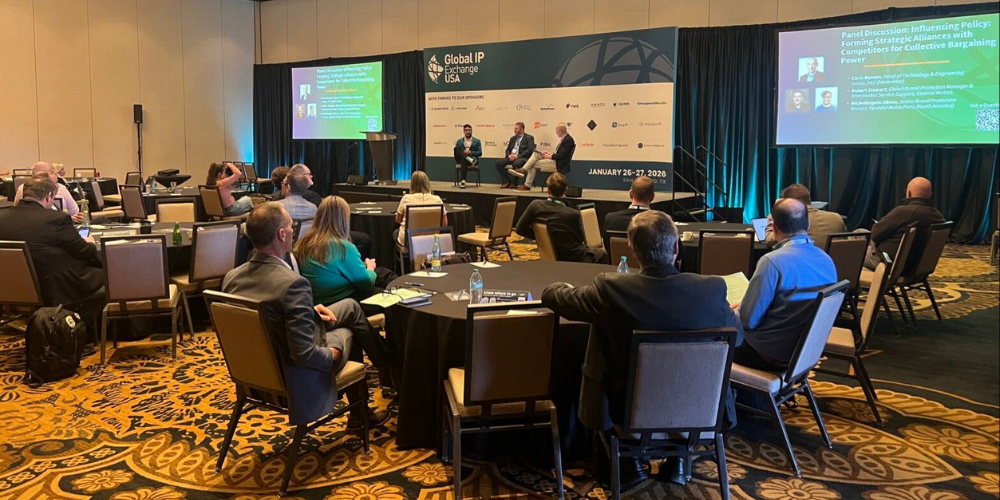
If there was one overarching theme throughout the conference, it was this: AI is here, and we need to figure out how to use it responsibly.
Earlier this week, I attended Global IP Exchange 2026, along with many IP professionals who braved winter storms raging across the U.S. While the conference was geared toward in-house teams, there were quite a few firms and technology companies in attendance, offering a diverse range of perspectives. The conversations ranged from practical AI tool recommendations to concerns about data security, and I left with both excitement about the possibilities and a clearer understanding of the challenges ahead.
The AI adoption reality
Perhaps the most striking observation was how universal AI tools have become. As one panelist put it: "Copilot - we're all using it." It was clear that most in-house teams at least have access to an enterprise version of Copilot, ChatGPT, or Gemini, and may also have specialized IP tools with AI applications. As a result, AI has become ubiquitous in a remarkably short time.
That being said, while the tools exist and are available to in-house teams, not everyone has figured out how to apply them, or may only use them for a few limited use cases today. One financial services company highlighted an AI translation tool they love, and multiple organizations discussed using AI for tasks such as email management and patent proofreading.
But here's the critical caveat that came up repeatedly: AI output, to borrow a quote, can be like an "over-eager undergraduate." You need to be knowledgeable enough to recognize when the output is nonsense. This isn't about avoiding AI. It's about using it with appropriate oversight.
Where organizations stand: Poll results
Two polls conducted during the conference provided valuable insight into where IP professionals actually are in their AI journey, and the results help explain many of the themes that emerged throughout the event.
When asked "What is your biggest barrier to wider AI use in patent/IP operations?", the responses were telling:
-
-
Internal resistance/change management: 39%
-
Regulatory/ethical concerns: 22%
-
Data quality and access: 17%
-
Accuracy/defensibility concerns: 13%
-
Budget constraints: 9%
-
The fact that internal resistance and change management topped the list at 39% is significant. The biggest challenge isn't the technology itself, the accuracy, or even the budget. It's getting people to adopt new ways of working and overcoming the fears that accompany them. This came up repeatedly in conversations throughout the conference, from discussions about training junior employees to concerns that firms might push back against tools that could disrupt their business models.
It's also interesting that budget constraints came in last at only 9%. This aligns with what I heard in sessions: organizations recognize they need to invest in AI, and see it as a way to actually cut costs in the long run. The question is how to do it thoughtfully rather than whether they can afford to do it at all.
The second poll asked: "How would you describe your organization's appetite for new IP technology?"
-
-
Cautious adopter: 40%
-
First-mover: 28%
-
Fast follower: 20%
-
Late/reluctant adopter: 12%
-
The largest group, "cautious adopters" (40%), perfectly captures the mood of the conference. People aren't rejecting AI (only 12% identified as late or reluctant adopters), but they're being deliberate about implementation. Combined with first-movers (28%) and fast followers (20%), we're seeing 68% of organizations actively engaged in AI adoption, just at different speeds and with varying levels of caution. In fact, many of the attendees came to the conference with the explicit purpose of researching tools and reporting back to their organizations as they build their AI workflows.
This cautious-but-committed approach makes sense given the data security concerns, regulatory uncertainty, and change management challenges that dominated so many conversations.
AI adoption progress
While the conference attendees were all eager to adopt AI for efficiency gains, many were still trying to figure out where and how to use it. There was quite a bit of interest in invention harvesting and disclosures, using AI for competitive landscaping, identifying licensing opportunities, or even infringement.
Meanwhile, the discussion around patent drafting tools revealed an interesting tension. The consensus in the room was that drafting tools aren't ready yet. Many of these in-house teams are relying on their firms to test this as they are handling the preparation and prosecution. While firms may argue that they are not experiencing the efficiencies needed to significantly reduce fees from these tools, they are certainly adopting and testing the technology at a rapid pace. AI-driven drafting technology is evolving rapidly, and what isn't ready today may be ready tomorrow. This point was emphasized repeatedly throughout the conference.
One area of strong agreement: mining your existing data is incredibly valuable. Companies need to view their patent program and central innovation database as untapped resources. Are you taking full advantage of the data you already have? The message was clear: get a solid tech stack to ensure data accessibility, maintain data quality, and support API integration.
Data security and vendor management: The elephant in every room
Concerns about confidentiality came up in virtually every session. This is understandable given that regulatory and ethical concerns were cited by 22% of respondents as their biggest barrier to wider AI use. The fundamental worry: we don't want confidential information sucked out of our organizations. Trade secrets have to stay out of tools like Copilot, and there's strong consensus that AI providers should not use client data to train their models.
The message to outside counsel was direct: tell us where the data is going. If you're using a third-party tool, we need to know about it. Companies are establishing AI policies, vetting tools through legal operations teams, and using internal tools whenever possible to stay within their security perimeters. Some organizations require mandatory employee training, track AI usage, and run compliance testing.
One speaker emphasized the importance of identifying operational blind spots and being laser-focused on building controls into your processes. The sophistication of vendor tools is impressive, but so many are adding AI functionality (sometimes vetted, sometimes not) that it requires constant vigilance.
Looking ahead: The shift toward internal AI ecosystems
Looking ahead, I expect a major shift in how organizations implement AI. Because in-house teams already rely on enterprise-approved AI tools, and are understandably reluctant to let sensitive data leave those environments, they will increasingly favor bringing external data in-house rather than sending proprietary information out. I expect more companies to build internal tools that combine public datasets (such as USPTO patent data, prior art, and industry benchmarks) with their own proprietary information, layered with business intelligence visualizations and conversational AI inside secure systems.
This approach lets teams leverage the benefits of AI while maintaining full control over their IP. Organizations that succeed in building these internal AI ecosystems will gain a clear competitive advantage, pairing AI-driven efficiency with the security and flexibility of keeping everything in-house.
This is the model Juristat is building. Rather than asking teams to move their data into a new AI system, Juristat delivers structured patent intelligence—examiner statistics, prior art outcomes, and comparable application history, for example—that can be brought directly into the GenAI tools teams already use. The result is AI that reasons with real prosecution context, without sacrificing control over sensitive IP. If this piques your interest, we’d love to chat.
The economics: We want to use AI, and we expect to share in the savings
In-house teams were remarkably direct: we absolutely want our firms to use AI, and we hope to share in the savings. There's genuine interest in exploring new billing models that reflect the reduced time required for certain tasks, with the expectation that those savings can be reallocated to other budget priorities.
This creates an interesting dynamic. Firms are under pressure to adopt AI to remain competitive and meet client expectations, but they're also navigating questions about how to bill for work that takes less time. Firm labor costs are rising, inflation is impacting margins, and firms are feeling the squeeze. Firms are challenged with the question of: what is more important, quality or efficiency? Can we really have both?
The skill regression concern
A sobering theme that emerged was concern about skill regression, especially among junior employees. If AI is doing the heavy lifting on first drafts, research, and other foundational tasks, how do newer attorneys develop the expertise they need? This isn't an argument against using AI. It's a call to be proactive about training and development.
This concern connects back to the 39% who cited internal resistance and change management as their biggest barrier. Successfully implementing AI goes beyond just having the right technology. It's ensuring your team develops the necessary judgment and expertise to use it effectively.
Legislative and policy landscape
There was also discussion around the current policy landscape, with a few key themes emerging around patent reform and AI regulation.
On the legislative front, PERA, PREVAIL, and RESTORE are all in play. These pieces of legislation focus on strengthening innovation and patent eligibility. The question is whether these will actually pass. While progress is slow and hard to predict, the current administration and legislative branch are both pro-patent, so if there's a time for reform, this would be it.
One particularly noteworthy piece of advice on AI legislation: be careful not to rush to legislate around AI. Let the courts do their job first, then build legislation based on how things develop. With AI changing so rapidly, passing legislation now could result in laws that become outdated almost immediately, and then you're stuck with them.
A key piece of advice for IP leaders was to stay engaged with the folks developing legislation around AI issues.
Five key takeaways
Several themes crystallized for me over the course of the conference.
1. We have to use AI and keep using it. The technology is changing so fast that we can't write it off based on current limitations. What it can't do today, it will likely be able to do tomorrow.
2. Review everything. Lack of proofreading is a big red flag. AI is a powerful tool, but it requires knowledgeable oversight. The fact that accuracy and defensibility concerns ranked relatively low (13%) in the barriers poll doesn't mean they're not important. It just means organizations recognize that with proper review processes, these concerns can be managed.
3. Tackle the change management challenge head-on. With 39% citing internal resistance as their biggest barrier, this isn't a problem that will solve itself. Organizations need to invest in training, build confidence through demonstrated value, and create clear policies that address legitimate concerns while enabling innovation. By focusing on a few key use cases and using AI to solve distinct organizational challenges, adoption and comfort levels will increase.
4. This is a moment to advocate for what matters to you. Whether it's negotiating billing arrangements that reflect AI efficiencies, pushing for better patent eligibility standards, or ensuring your vendors are transparent about their AI tools and data practices, now is the time to make your voice heard.
5. Be thoughtful about training and development. As AI takes on more tasks, we have to ensure we're not creating a generation of attorneys who never develop fundamental skills.
AI presents tremendous opportunities for efficiency and innovation in IP practice, but it requires thoughtful implementation, strong oversight, and clear communication between in-house teams, outside counsel, and vendors. The organizations that succeed will be those that embrace the technology while maintaining rigorous quality standards and staying focused on the fundamentals of good IP practice.
The organizations that pull ahead won’t just adopt AI—they’ll use it to elevate standards and sharpen strategy. Juristat gives IP teams the data-driven insight needed to turn AI into a true competitive advantage. Learn how with a Juristat demo.